Industry Background
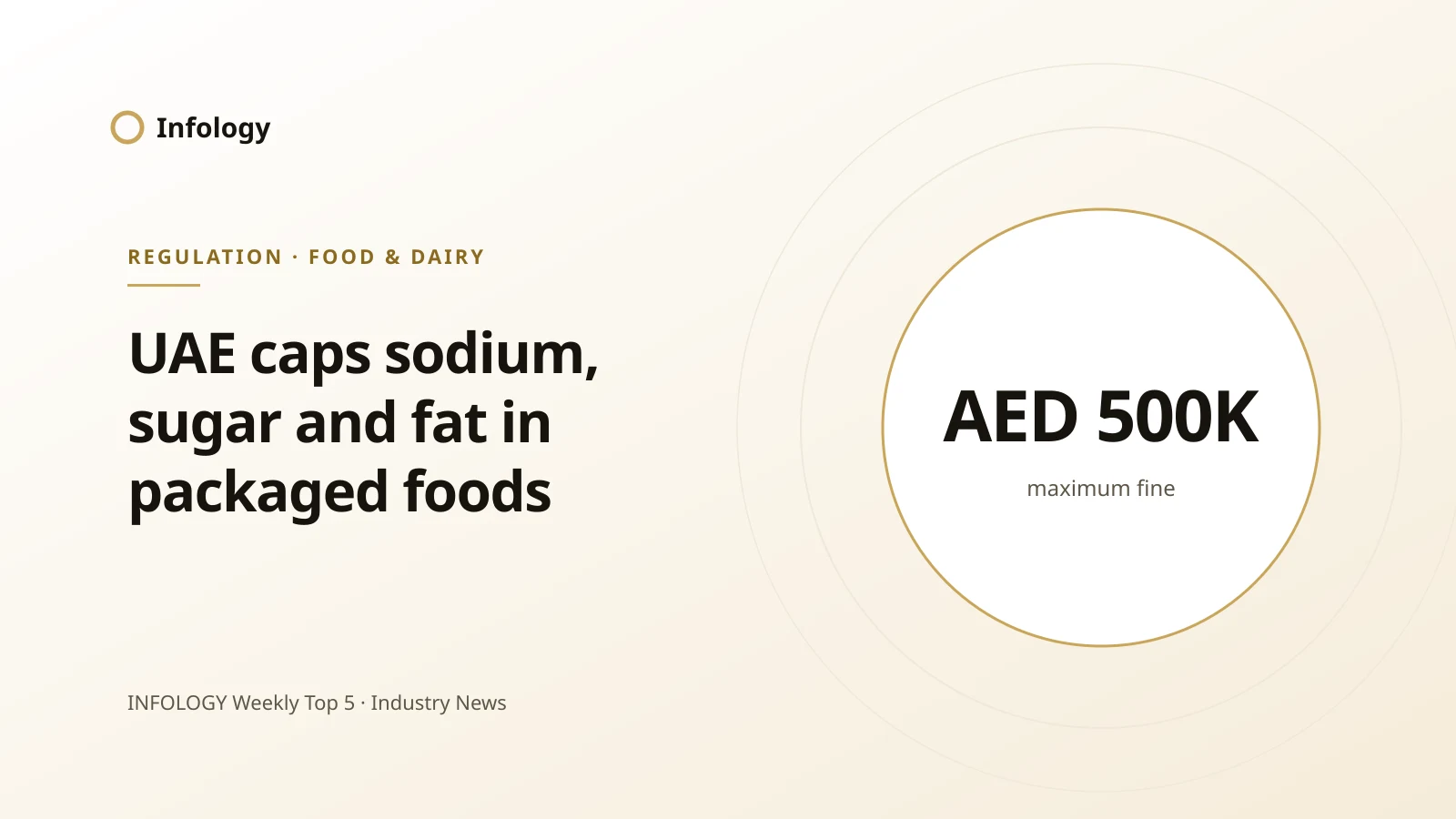
The Ministry of Health and Prevention describes the resolution as a national framework to reduce the targeted ingredients gradually. Reported first-phase limits include 9.6g total sugar per 100g for sweetened milk drinks (8g final) and 12g for flavoured yoghurt and laban (10g final). Bread, salted crackers, nuts, pretzels, extruded snacks and processed cheese are also covered.
Group 1 products (bread, sweetened milk drinks, flavoured yoghurt and laban, salty snacks) have up to nine months to meet first-phase limits; processed cheese has two years and three months. Existing stock may be sold for up to one year. Exception applications are due within 30 days of the effective date and require a commitment to at least a 20% reduction in the first phase. Products made solely for export are exempt. The reports reviewed do not state the resolution number or effective date. The measure sits alongside the sugar-tiered drinks excise in force since January 2026.
Why This Matters
The UAE is moving from price signals (excise) to product standards (compositional caps). Excise changes consumer prices; compositional caps determine what may legally be sold. Together they narrow the room for high-sugar, high-sodium recipes and make reformulation a compliance requirement rather than a marketing choice.
Implications for Businesses
Food and dairy manufacturers need a category-by-category gap analysis against the first-phase and final limits, with reformulation timelines that fit the nine-month and 27-month windows. Ingredient suppliers of sugar-reduction systems, salt replacers and texturisers gain demand. Retailers should plan for delisting risk once stock sell-through periods expire. The 20% threshold in the exception route means that firms needing deeper cuts must document why, and commit to progress.
Interpretation: early movers can use compliance as a quality story, while late movers face compressed R&D schedules.
Implications for the UAE Market
Dubai and Abu Dhabi, as the main import and distribution hubs, will see the greatest effect on imported flavoured dairy, snacks and bakery lines. Free-zone status offers no shelter for goods sold domestically. Local producers with reformulation capability gain relative advantage.
Interpretation: juice and beverage makers should expect pressure to extend similar logic to adjacent categories, as already seen in Al Ain Farms Group's reported 10–20% added-sugar cuts across some juices and dairy.
Implications for International Companies
US and Georgian exporters of dairy, snacks, bakery and processed cheese must test their existing recipes against the UAE limits before shipping. Products with sugar or sodium profiles above the first-phase caps may need regional recipes or co-packing. Companies selling only into export channels via the UAE are exempt, but domestic sales trigger compliance. Early engagement with importers on labelling, documentation and exception procedures reduces the risk of rejected consignments.
Suggested Actions for Executives
- Map every UAE-sold SKU against first-phase and final limits and quantify reformulation cost.
- Decide within 30 days of the effective date whether to file for an exception.
- Sequence reformulation to protect taste acceptance and test with consumers.
- Review stock and inventory so non-compliant goods are sold within the allowed period.
- Prepare a compliant UAE product specification before new market entry.
INFOLOGY Perspective
The practical question for decision-makers is how quickly compliance can be turned into a commercial advantage. INFOLOGY Management Consulting helps businesses interpret regulatory change, benchmark competitors and design market-entry strategies for the UAE and GCC.
Sources: Khaleej Times; The National, 8 Oct 2026; The National, 7 Oct 2026.